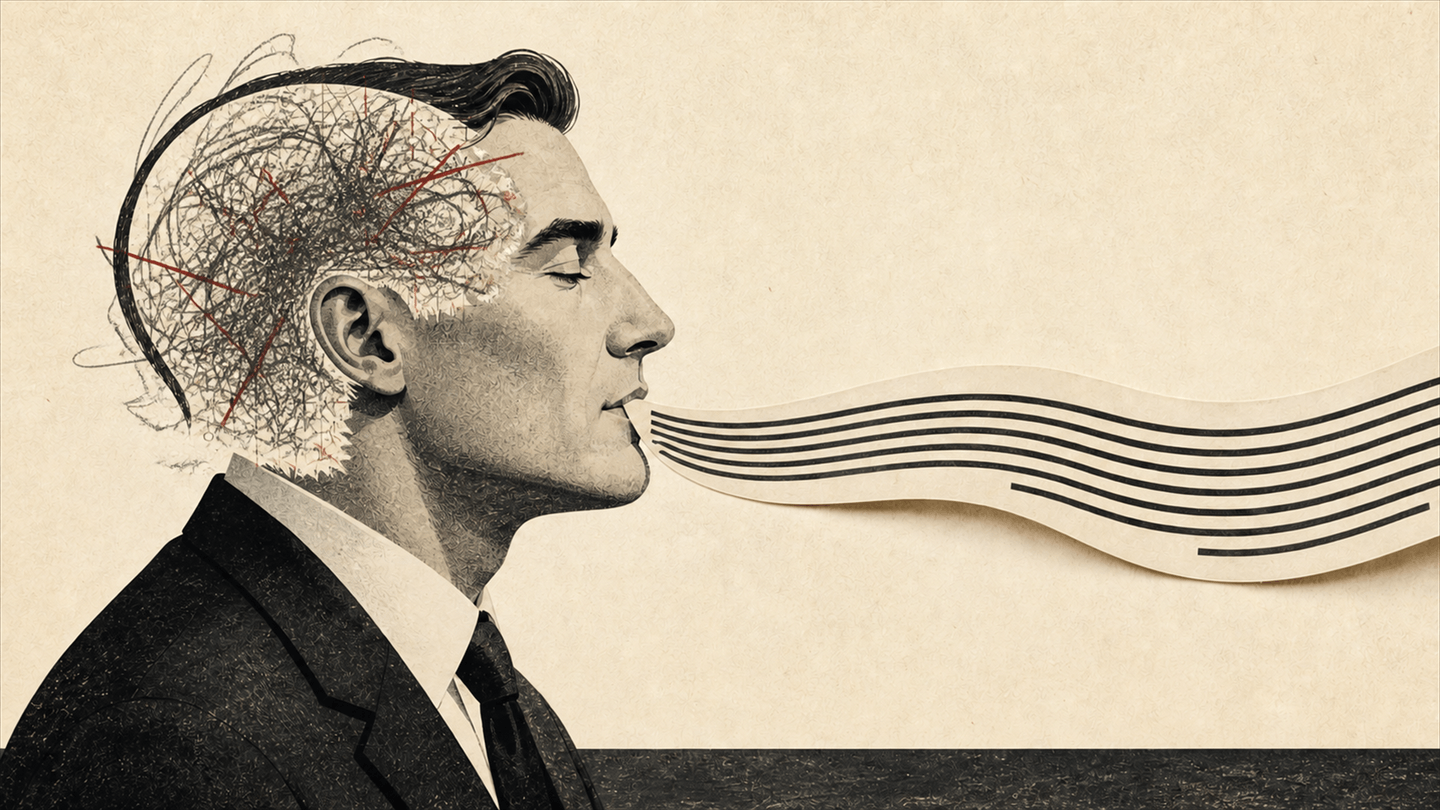
Professional-looking language can conceal that nobody decided who acts or what changes.
Have you ever left a meeting with a page of professional-looking notes and no idea who agreed to do what?
“The matter will be taken forward.”
By whom? Taken where? What will happen next?
The sentence sounds proper. It tells me almost nothing.
It can still pass through a meeting, report or email without challenge because the words sound finished. The thought underneath is not.
That is the trap. Language can clarify thought. It can also save us from doing the thinking.
George Orwell wrote about that problem 80 years ago in Politics and the English Language. The technology has changed. The habit has not.
I first met Orwell in high school through Nineteen Eighty-Four. The book left one clear thought with me: oppression does not always kick down the door. It can creep in while people grow used to new rules and smaller freedoms.
Nobody mentioned the essay. When I finally read it, I found something more immediate than a warning about political language. I found a practical test for reports, speeches, meeting notes, professional advice and normal conversation.
In the novel, Newspeak is an extreme system. Reduce the language and you reduce the thoughts people can express. The everyday relative is quieter. We use familiar phrases to hide an act, avoid naming the person responsible or cover the fact that we have not decided what we mean.
Nobody needs to invent Newspeak. We already have ready-made phrases that save us the trouble.
Smooth writing can hide weak thought
I had written in a smooth but grounded way since school. The essay still gave me a harder test.
Is every word doing a job?
Have I named the person who acts?
Am I explaining something, or making it sound important—making ME important?
That last question is uncomfortable. It should be.
A long word may be the right word. A technical term may be needed. Yet people also use hard language to show rank or keep others from asking questions. It can provide cover when the writer is unsure.
I have done it. Oh, have I done it! Most people who write for work probably have.
Sometimes we do not know exactly what we mean. A familiar phrase covers the gap and lets us move on.
The reader receives a finished sentence. The thought underneath it is unfinished.
Orwell’s rules are simple. Using them is not.
Orwell asks the writer to avoid worn-out figures of speech. Use a short word when it will do. Cut words that add nothing. Prefer the active voice. Choose ordinary language over jargon.
Then he gives himself a way out: break the rules before writing something awful.
That matters to me. Plain language is not a machine that cuts every sentence to six words. It does not ban humour or technical knowledge. It asks the writer to choose words for their meaning.
The work is in the choosing. This elevates language and thinking.
This reaches beyond writing
Words affect what people understand. They affect what people do next.
A vague action in a meeting may leave a job undone. A consultant can make a simple issue sound too difficult for the client to challenge. A manager can hide an order inside soft language and later blame the employee for missing it.
At home, people can talk for an hour without saying what hurt them or what they want to change.
The language may be polite. The result is still confusion.
This is why I want to look at Orwell’s essay from several parts of life. Responsibility disappears when nobody is named. Influence changes how words land. AI can produce fine sentences before anybody has supplied a clear thought. Plain language matters in my native Finnish and every other language too.
I am not trying to turn Orwell’s rules into another writing method with a logo.
Before sending the next important message, I want to stop at one polished sentence and ask a more basic question:
What did I actually mean?