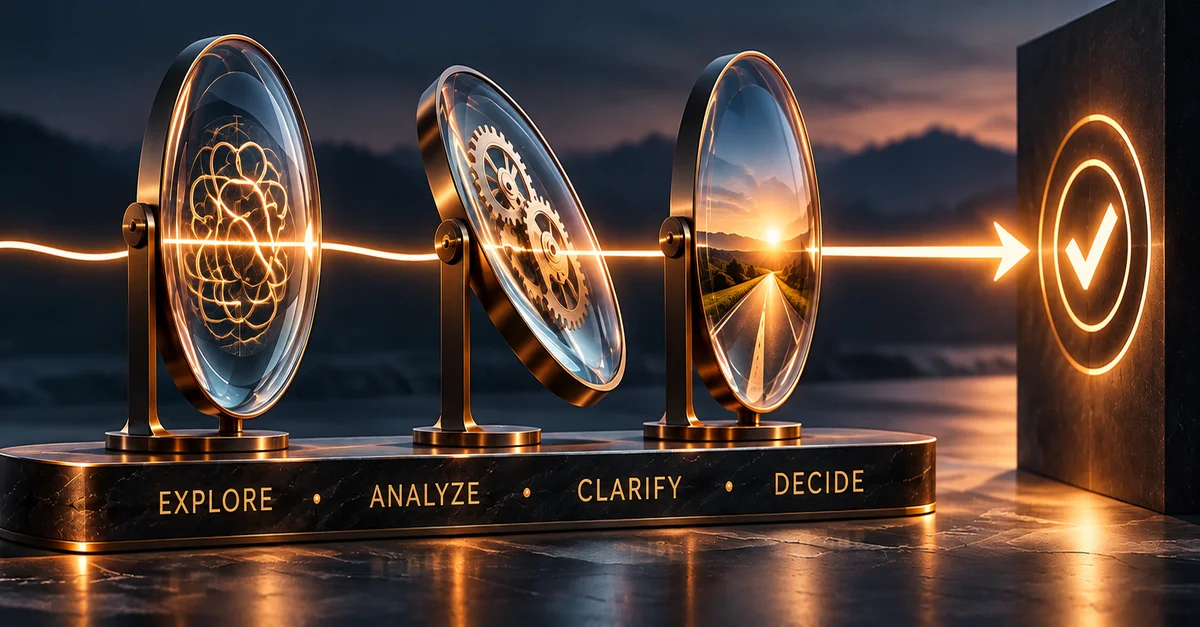
In the first article of this series, I argued that management methods are interchangeable lenses. In the second, I showed how the lens can change during an investigation without losing the original line of reasoning.
There is another question that deserves attention, and I think it is one that consultants and managers are often rather reluctant to ask.
When have we done enough analysis?
Because there is always another method available. Another workshop, another diagram, another round of interviews. And, naturally, another impressive presentation explaining why we need to investigate a little further.
I have seen enough of that to become suspicious when somebody announces that the next step is yet another analysis.
Sometimes it is absolutely necessary. Sometimes it is simply a very sophisticated way of avoiding a judgement. It’s always the question of what’s not enough and what’s too much.
More analysis does not automatically mean better understanding
Imagine a company struggling with declining margins.
The management team has already examined pricing, material costs, productivity, capacity utilisation and customer mix. Several important causes have been established. Some uncertainties remain, as they almost always do.
Then somebody suggests another workshop. Perhaps a SWOT. Perhaps a deeper root-cause exercise. Perhaps a complete process mapping exercise across the entire operation. All perfectly respectable techniques.
But what, exactly, are we expecting to learn? And more importantly, what would we do differently depending on the answer?
That second question is where things become interesting.
If the additional work could materially change the conclusion, the priorities or the next decision, there may be an excellent reason to continue.
If nobody can explain what difference the result might make, I would seriously question the value of doing it.
A method is supposed to help us see something important. It does not earn its place merely by being available.
The uncomfortable business of professional judgement
There is a certain comfort in following a method.
It has steps. It has instructions. It usually has a template. And when the template is completed, there is something tangible to show for the effort.
Professional judgement is less comfortable. It requires somebody to say, "We have enough evidence to reach this conclusion." Or, equally important, "We are still missing something that could change the conclusion."
Neither statement can be made responsibly simply because we have filled the last row on a worksheet. And that is precisely why I think method selection and method termination belong to the same professional discipline.
We need judgement to select the appropriate lens. We need judgement to recognise when another lens would reveal something important. And we need judgement to recognise when the work has reached a reasonable stopping point.
The last of those is often the most difficult.
Uncertainty is not an excuse to investigate forever
Let me make one thing clear. I am not suggesting that we should settle for convenient answers.
A plausible explanation is not necessarily a correct explanation. Agreement around a meeting table is certainly no proof. And a consultant who declares the investigation finished because the assignment budget is exhausted has hardly demonstrated professional excellence.
But absolute certainty is rarely available in organisational work.
There will be incomplete records, conflicting observations, human interpretations and circumstances that change while we are studying them.
The question is whether the remaining uncertainty is material. Could it change our understanding of the problem? Could it change which alternatives deserve serious consideration? Could it expose a risk that would make the intended decision irresponsible?
If yes, investigate. If no, what exactly are we waiting for?
I sometimes think we have become so fascinated by the machinery of analysis that we forget its purpose.
We are trying to reach a sound professional judgement under real-world conditions. We are not trying to win a competition for the largest collection of analytical material.
The danger of the beautiful report
There is another trap here.
A thorough report can create the impression that everything important has been understood. The diagrams are consistent. The numbers reconcile. The conclusions follow logically from the assumptions.
That seems very impressive.
But were the assumptions challenged? Were the observations representative? Did somebody speak with the people who actually know how the work happens? Were inconvenient findings retained, or quietly explained away because they disturbed the preferred conclusion?
A polished analytical result can still be professionally weak. And an unfinished-looking investigation can sometimes contain exactly the evidence needed for a sound decision.
The quality of reasoning cannot be measured by the weight of the report. Nor by the number of methods used to produce it.
A stopping point is a professional conclusion
So how do we know when to put the tools away?
I would ask whether the original question has been answered sufficiently for the decision at hand.
Then I would look at what remains uncertain and ask whether resolving it could materially change that answer.
Finally, I would challenge the proposed next analytical step:
What could we learn that would make us think or decide differently?
If there is a convincing answer, continue. If there isn't, perhaps it is time to stop polishing the analysis and present the judgement, including its limitations.
This does not mean pretending that uncertainty has disappeared. A sound conclusion should distinguish what has been established, what is reasonably inferred and what remains open.
That is part of the professional work. And if new evidence later challenges the conclusion, we should be perfectly willing to reopen it. That too, is professional.
Changing our mind because the evidence changes is a strength. Refusing to reach a judgement because some uncertainty remains is quite another matter.
The method has finished its job. Has the reasoning?
I have no objection to using several management techniques in the same investigation. Sometimes that is exactly what the situation requires. In fact, I find that that is the case most often.
But each one must earn its place by contributing something material to the reasoning. And each one must be allowed to finish.
Otherwise, the work becomes an endless procession of perfectly respectable techniques, each producing its own perfectly respectable output, while the original question waits patiently for somebody to answer it.
That is an expensive way to look busy.
The first article argued that the method is a lens. The second argued that the lens may need to change during the work.
My third position is simple:
Know when to change the lens. Know when to look more closely. And know when you have seen enough to make a professional judgement.
The last one takes rather more courage than completing another template.
If your organisation is collecting analyses faster than it is reaching useful conclusions, perhaps we should have a conversation.
My work begins with discovery and diagnosis, followed by a clear briefing of findings and an actionable plan. You can contact me here on LinkedIn to arrange an initial discussion, or visit www.baleteworks.com.
No strings attached.